> For the complete documentation index, see [llms.txt](https://agents.glueckkanja.com/llms.txt). Markdown versions of documentation pages are available by appending `.md` to page URLs; this page is available as [Markdown](https://agents.glueckkanja.com/agents/insider-risk-profiler/overview.md).
# Overview
> **SCU Cost Estimate**\
> This agent typically consumes **0.2 – 1.5 SCUs per analysis run**, depending on the number of Insider Risk Management (IRM) alerts and the depth of enrichment (Quick, Standard, or Deep mode). Larger environments with high alert volumes or extended lookback windows may consume more SCUs.
### Introduction
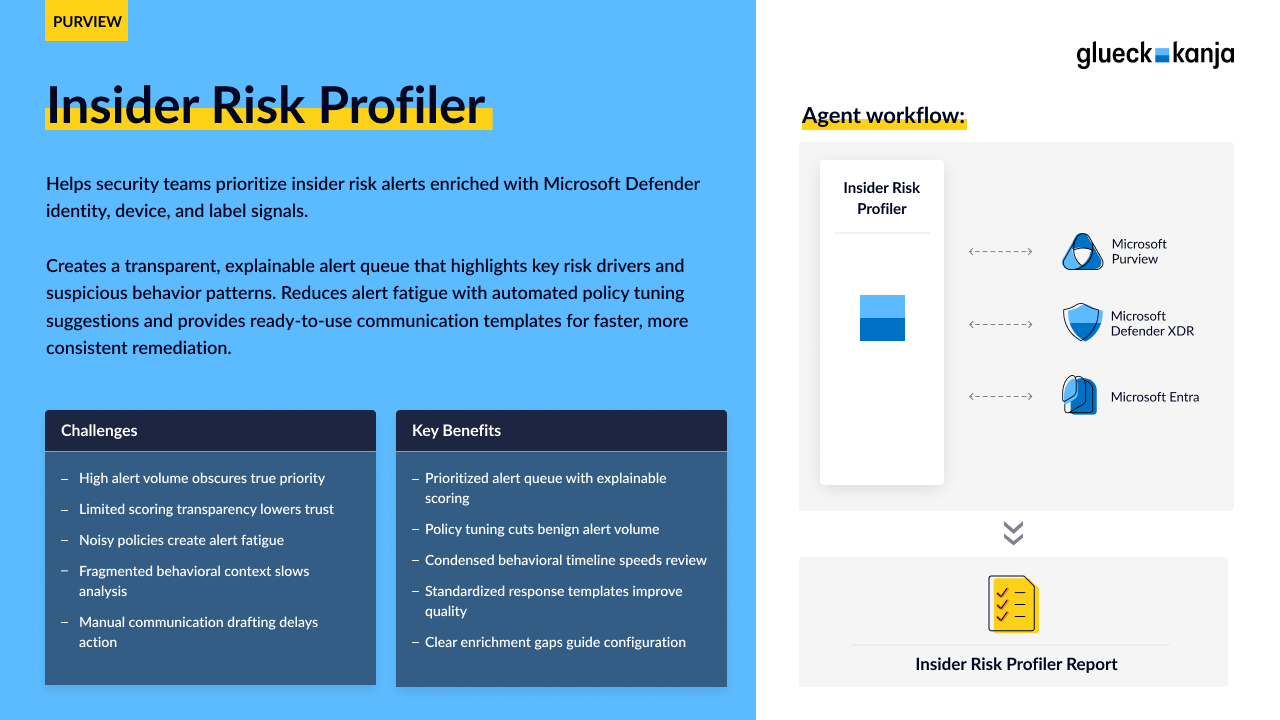
**Insider Risk Profiler** helps security teams focus on what truly matters by turning noisy insider risk alerts into actionable intelligence. Instead of manually correlating signals across Purview, Defender, and Entra, the agent builds a unified risk profile that highlights which alerts pose genuine insider threats and why.
It automatically enriches IRM alerts with identity risk, device compliance, and data protection signals, creating a prioritized queue with clear scoring and contextual narratives. The result: faster triage, fewer false positives, and confident remediation decisions.
***
### What It Does
* Enriches Purview Insider Risk alerts with Defender identity, device, and activity telemetry
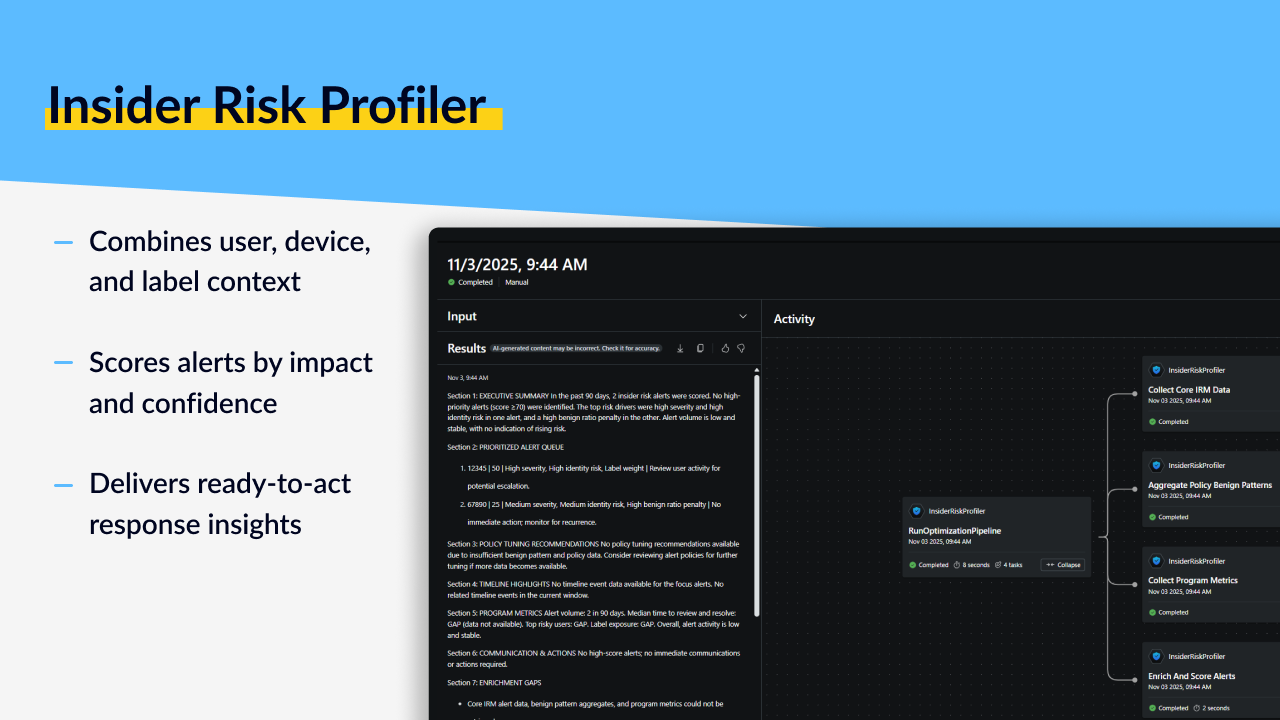
* Prioritizes alerts based on composite scoring (identity, activity, and data risk)
* Reduces alert fatigue by highlighting explainable risk factors and policy tuning insights
* Correlates behavior across email, file, and cloud activities to reveal exfiltration patterns
* Flags enrichment gaps and suggests improvements to telemetry coverage
* Provides pre-built investigation and notification templates for rapid response
***
### Use Cases
#### 1. **Focusing on the Right Alerts**
Hundreds of IRM alerts can appear daily, but not all deserve equal attention. Insider Risk Profiler applies transparent scoring logic, surfacing high-priority alerts involving risky users, compromised accounts, or sensitive data exposure. Analysts instantly know what to investigate first.
#### 2. **Accelerating Investigations**
Traditional IRM triage requires jumping between multiple portals and data sources. This agent consolidates identity, activity, and DLP data into a unified behavioral timeline. Analysts see what happened, when, and why it matters, saving hours of manual correlation.
#### 3. **Reducing Noise and Alert Fatigue**
Overly broad policies often trigger false positives. Insider Risk Profiler identifies benign or low-impact patterns, recommends policy tuning adjustments, and highlights redundant alert sources, letting your team focus on true insider threats.
#### 4. **Enhancing Confidence and Transparency**
Security leaders often ask: *Why is this alert high priority?* The agent explains the score by listing contributing factors such as recent off-hours logons, DLP violations, or failed authentication attempts. This improves trust in automation and scoring models.
#### 5. **Standardizing Response and Communication**
From analyst notes to user or manager notifications, the agent generates structured response templates with consistent tone and legal phrasing, ensuring that every incident is handled swiftly and compliantly.
***
### Why Insider Risk Profiler?
#### Challenges It Solves
* High alert volume makes it hard to see true risk
* Alert scoring lacks transparency and explainability
* Redundant or noisy rules waste analyst time
* Context from behavior sequences (collection → exfiltration) is fragmented
* Response communication is slow and inconsistent
#### Benefits You Get
* Explainable, prioritized alert queue with clear scoring factors
* Policy optimization recommendations to cut benign alerts
* Condensed behavioral timeline linking risk signals across sources
* Standardized, ready-to-use communication templates
* Clear enrichment gap analysis to improve telemetry coverage
***
### How It Works
#### What Goes In
* Purview Insider Risk alerts and metadata
* Microsoft Defender identity and device risk signals
* Cloud app, email, and file activity telemetry
* DLP violation and behavioral anomaly events
* User and group directory context (Entra ID)
#### What It Does
* Correlates alerts with identity, device, and data signals
* Enriches user activity across multiple telemetry sources
* Computes multi-dimensional risk scores (Identity 40%, Activity 30%, Data 30%)
* Assigns alerts to priority bands (Critical, High, Medium, Low)
* Generates a structured triage narrative and recommended remediation steps
#### What You Get
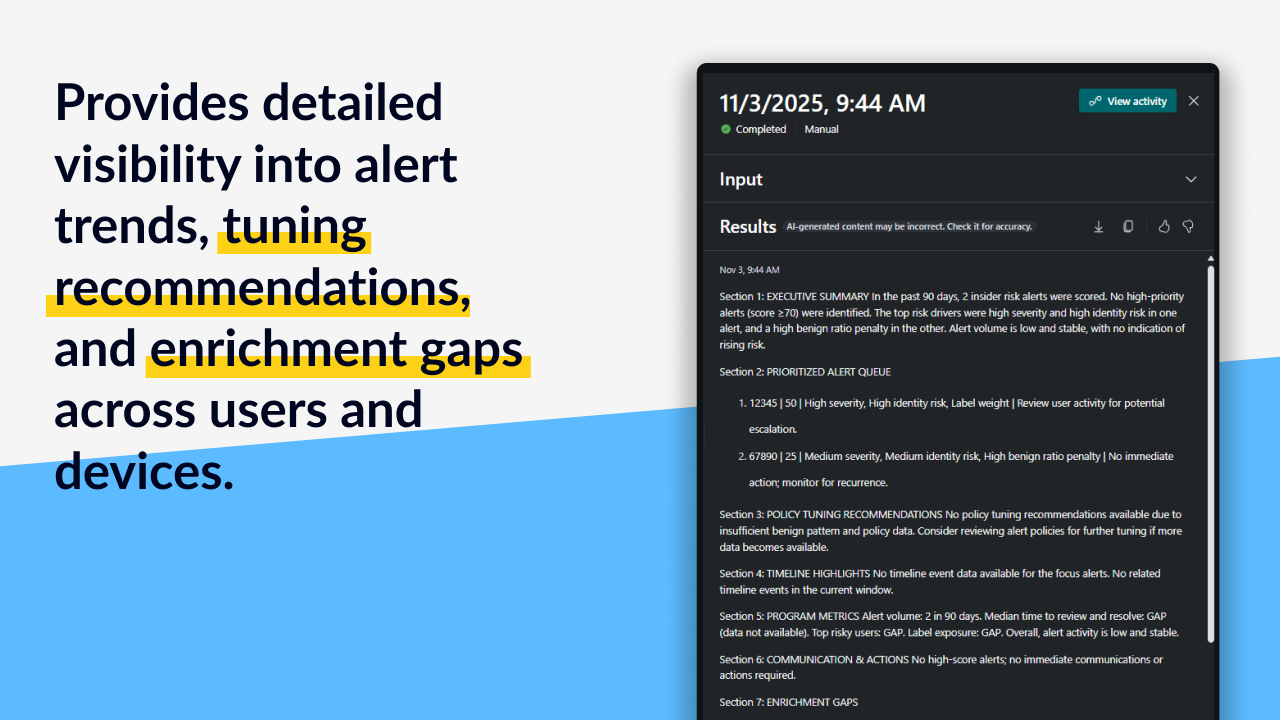
* Executive summary with prioritized alerts and score distribution
* Top 10 prioritized alert queue with key drivers
* Policy tuning and enrichment improvement suggestions
* Structured remediation guidance and response templates
* Exportable triage report for documentation or audit purposes
---
# Agent Instructions
This documentation is published with GitBook. GitBook is the documentation platform designed so that both humans and AI agents can read, navigate, and reason over technical content effectively. Learn more at gitbook.com.
## Querying This Documentation
If you need additional information that is not directly available in this page, you can query the documentation dynamically by asking a question.
Perform an HTTP GET request on the current page URL with the `ask` query parameter, and the optional `goal` query parameter:
```
GET https://agents.glueckkanja.com/agents/insider-risk-profiler/overview.md?ask=&goal=
```
`ask` is the immediate question: it should be specific, self-contained, and written in natural language.
`goal` is optional and describes the broader end goal you are ultimately trying to accomplish on behalf of the user. GitBook uses it to tailor the answer towards what is most useful for that goal.
The response will contain a direct answer to the question and relevant excerpts and sources from the documentation.
Use this mechanism when the answer is not explicitly present in the current page, you need clarification or additional context, or you want to retrieve related documentation sections.